- QuickStaged
- Labelling rules
Labelling virtually staged photos: the rules in the UK, Canada and California
None of these markets bans virtual staging. All of them ask for the same two things: the furniture must not misrepresent the property, and the buyer must be told. Below, each rule in its own words, linked to where it is published.
Checked against the sources on 26 November 2026. A summary for listing agents, not legal advice: the linked text is what counts.
The short version.
| Market | Who says it | What it asks | Set wording? |
|---|---|---|---|
| United Kingdom | The DMCC Act 2024; the Property Ombudsman's code; Rightmove | No misleading presentation; on Rightmove, AI images clearly labelled and shown with current photos of the room | No |
| Ontario | RECO; Toronto's board, TRREB | Clearly label digitally altered images; staging must reflect permanent features | No |
| British Columbia | BCFSA | Label photos that have been altered and enhanced | No |
| Alberta | RECA; Calgary's board, CREB | Clearly disclose AI-generated or altered images; in Calgary, in the public remarks | No |
| Québec | OACIQ | A clear and visible statement in the advertisement | A minimum: “Image generated by artificial intelligence.” |
| California | Business and Professions Code §10140.8 (AB 723) | A statement on or next to the image, and a link or QR code to the original | What it must say, not the words |
United Kingdom: no set label, but a misleading photo is unlawful.
The law: the Digital Markets, Competition and Consumers Act 2024
Its rules on unfair commercial practices took effect on 6 April 2025 and replaced the Consumer Protection from Unfair Trading Regulations 2008. Section 225 prohibits unfair commercial practices. Under section 226, a practice is a misleading action if it involves
“an overall presentation which is likely to deceive the average consumer about a matter relating to a product, a trader or any other matter relevant to a transactional decision”
and “an overall presentation may be deceiving even if the information it contains is true”. Section 227 adds misleading omissions: leaving out “information that the average consumer needs to take an informed transactional decision”, including giving it in a way that is unclear or untimely.
The Competition and Markets Authority's guidance, CMA207 (updated 18 November 2025), confirms that a product includes “immovable property, such as the sale or lease of land”, and lists “whether to agree to a sales presentation or view a property” among transactional decisions. So a photo that misleads a buyer into booking a viewing can fall within the Act.
The Property Ombudsman's code
The Code of Practice for Residential Estate Agents (England, Wales and Northern Ireland), paragraph 7i, asks members to take “all reasonable steps to ensure that all statements that you make about a property, whether oral, pictorial or written, are accurate and are not misleading”. A photo is a pictorial statement.
Rightmove
Rightmove's Agent and Developer Technical Guidelines (January 2026), paragraph 10, call content “generated and/or manipulated by AI” an Enhanced Edit and permit it “provided that these adjustments/enhancements do not misrepresent the property”. Enhanced Edits must be:
- “accompanied by current, accurate images of the room and/or property; and”
- “clearly labelled as being AI or otherwise enhanced.”
Rightmove reserves the right to remove content it believes does not comply. We found no published rule of this kind from Zoopla or OnTheMarket on 26 November 2026; the Act applies to listings on every portal.
In practice
- Keep a “Virtually staged” label on the image and show the original photo next to it.
- Add a line to the description saying which photos are staged and that the furniture does not come with the property.
- For a let advertised unfurnished, say “unfurnished” next to a staged photo.
- Never let staging change the room itself: walls, windows, fixtures, flooring, the view, or damage a buyer should see.
Canada: the provinces regulate, and boards add their own rules.
The Canadian Real Estate Association does not regulate AI use in listings; it told Real Estate Magazine in March 2026 that its code's advertising articles “may be engaged” by misuse of AI and pointed to provincial regulators and local MLS® rules.
Ontario — RECO
RECO's guidance on the use of artificial intelligence (published 22 October 2026) says brokerages and agents must:
“Maintain visual transparency: Ensure virtual staging or AI modifications accurately reflect permanent features and clearly label any digitally altered images.”
It lists sections 26, 34, 35 and 37 (false advertising) of the Trust in Real Estate Services Act, 2002 and sections 5, 8 and 12 of the Code of Ethics (O. Reg. 365/22). Toronto's board, TRREB, told Real Estate Magazine that colour correction, brightness and contrast changes and virtual staging are permissible “provided such edits do not materially alter the factual accuracy of the image or misrepresent any feature, condition, or view of or from the property”.
British Columbia — BCFSA
BCFSA's Artificial Intelligence Guideline (published 22 February 2024):
“While it may be okay to use an AI tool to virtually stage a house, you should label photos or videos that have been altered and enhanced so you do not mislead a potential buyer.”
Among the rules it cites are sections 40 and 41 of the Real Estate Services Rules, the second of which prohibits false or misleading advertising. In 2024 BCFSA upheld a $6,000 penalty against a Kelowna agent whose listing photos were altered to hide peeling paint and show furnishings that did not exist, as reported by Real Estate Magazine.
Alberta — RECA
RECA's information bulletin Use of Artificial Intelligence (November 2026), under Rule 42 (licensees must not mislead clients or the public):
“AI-modified property images must not be presented or reasonably taken as the current condition of a property. If an image is AI-generated or AI-altered, that fact must be clearly disclosed.”
Calgary's board, CREB, prohibits virtually enhanced photos that misrepresent a property in a way that would affect its value, and permits “virtual staging with realistically sized, unattached furniture”, which “must be disclosed in the public remarks on the listing”, according to Real Estate Magazine. CREB said non-compliant images are flagged weekly.
Québec — OACIQ
The OACIQ's advertising guideline, section 6.3.1, is the only rule here with a minimum wording:
“Advertisements must include a clear and visible statement, such as: ‘Image generated by artificial intelligence.’”
It applies, among other cases, when AI is used to “carry out virtual staging or visual transformations” or to change a property's appearance “e.g., adding furniture”, and brokers remain responsible for the accuracy of advertisements produced with AI. Our label reads “Virtually staged”, so in Québec the OACIQ statement has to be added to the advertisement.
California: a statement and the original, by law.
Business and Professions Code §10140.8, added by AB 723 and in force since 1 January 2026, applies to a broker or salesperson who uses a digitally altered image to advertise real property for sale. They must include:
- a statement that the image has been altered, “reasonably conspicuous and located on or adjacent to the image”;
- “a link to a publicly accessible internet website, URL, or QR code that includes, and clearly identifies, the original, unaltered image”, with wording saying the unaltered images can be seen there;
- on a website the agent controls, the unaltered version in the posting itself, or such a link.
“Digitally altered image” expressly includes adding furniture with photo editing software or artificial intelligence. Lighting, white balance, colour correction, straightening, cropping and other common adjustments “that do not change the representation of the real property” are excluded.
What comes with every photo, and what stays with you.
Every staged photo carries a “Virtually staged” label, arrives with your untouched original, and comes with a line for the listing: “Photo virtually staged: the furniture and decor were added digitally and do not come with the home. The original, unstaged photo is shown alongside.”
A vision model compares each staged photo with your original, twice: windows, doors, walls, fixed features, flooring and the view must be unchanged, and nothing may cover damage visible in your photo. If the check is not sure, a person looks before it goes out.
Put the line where your rules want it (the description, the caption or the public remarks), show the original next to the staged photo, add the OACIQ statement in Québec, and in California link to the originals or show them in the posting.
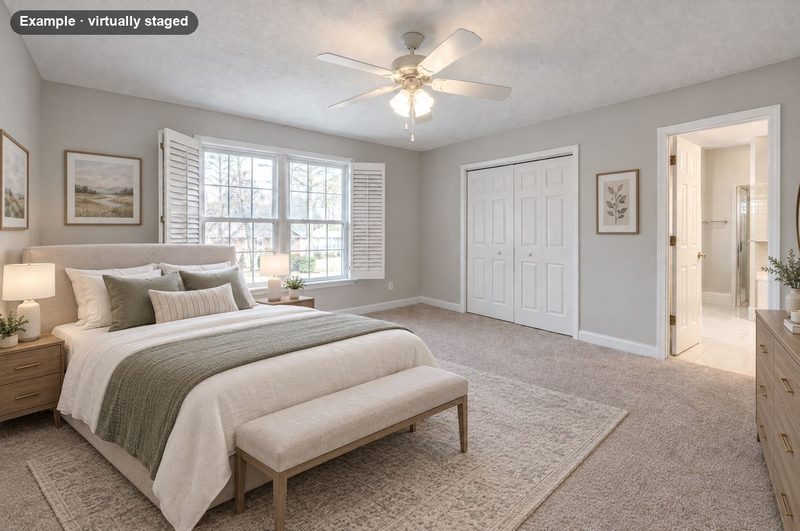
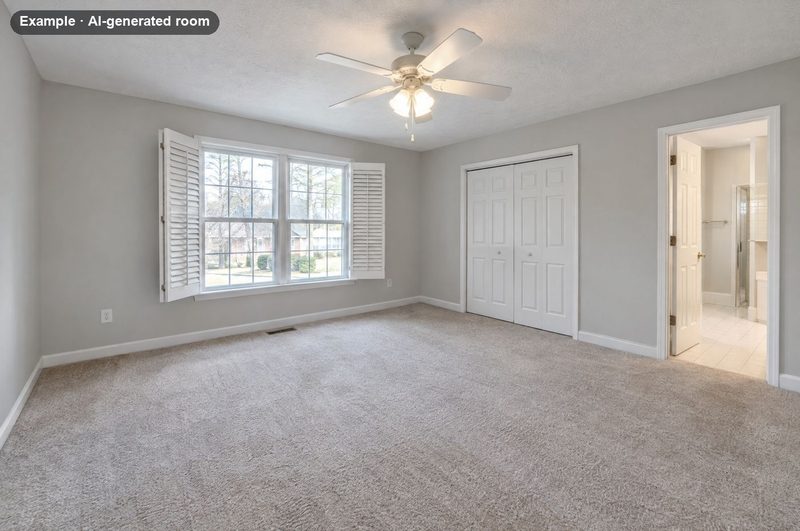 BeforeVirtually staged
The label on our examples reads “Example · virtually staged”, because they are rooms we generated. On your photos it reads “Virtually staged”.
Yes, in every market on this page, as long as the staged photo does not misrepresent the property and buyers are told. RECO, BCFSA and the OACIQ name virtual staging explicitly, and Rightmove permits AI-made images that are labelled and shown with current photos of the room.
On Rightmove, enhanced images must be accompanied by current, accurate images of the room. In California the law requires the original, or a link or QR code to it. Elsewhere it is not written into the rules quoted here, but showing it is the clearest way to make sure the staged photo isn't taken for the room's current condition.
Only Québec sets a minimum (“Image generated by artificial intelligence.”), and California says what the statement must cover. Elsewhere a plain line works: say the photo is virtually staged, that the furniture does not come with the home, and where the original is.
The rules quoted here are addressed to agents and brokerages: RECO says the use of AI “does not transfer professional responsibility to a technology provider”. We make it easy to comply, with the label, the original and the line; placing them in the listing is yours.
- Digital Markets, Competition and Consumers Act 2024, sections 225, 226 and 227, in force 6 April 2025 (S.I. 2025/272).
- Competition and Markets Authority, Unfair commercial practices (CMA207), updated 18 November 2025.
- The Property Ombudsman, Code of Practice for Residential Estate Agents, paragraph 7i.
- Rightmove, Agent and Developer Technical Guidelines, January 2026, paragraph 10.
- RECO, RECO guidance: use of artificial intelligence, 22 October 2026.
- BCFSA, Artificial Intelligence Guideline, 22 February 2024.
- RECA, Use of Artificial Intelligence, information bulletin, November 2026.
- OACIQ, Guideline on advertising, section 6.3.1.
- California Legislative Information, Business and Professions Code §10140.8 (Stats. 2025, ch. 497, AB 723), effective 1 January 2026.
- Real Estate Magazine, Enhancing vs. misleading: real estate's AI photo evolution enters enforcement phase, 30 March 2026: the statements of CREA, TRREB and CREB and the BCFSA penalty.